Share
DYPA parental leave in Greece: up to €758/month, conditions apply
10/08/2026
4 min
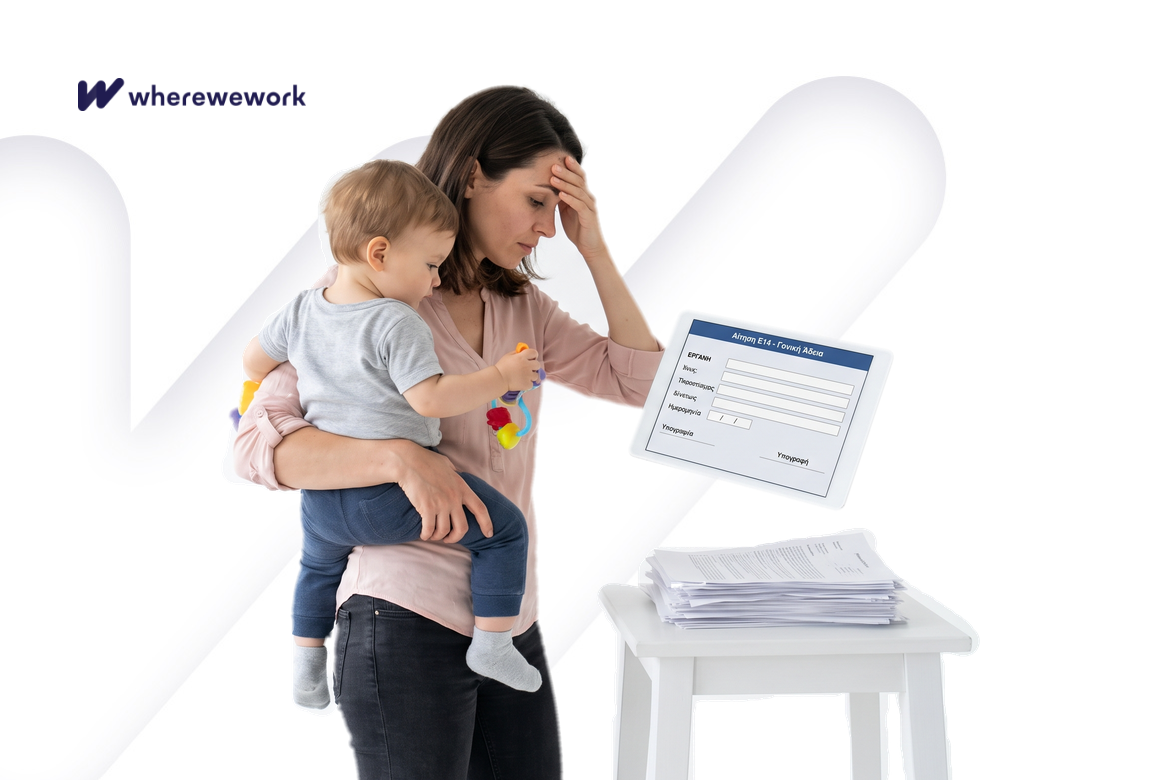
You have a child under eight, you want to take parental leave, and you have just found out that the Greek Public Employment Service (DYPA) pays a subsidy of up to €758 net per month for two months while you are away. Good news, until you read the fine print: your employer has to file a specific form on ERGANI before you can even apply. If they do not, your claim is dead on arrival, no matter how eligible you are.
Here is what the benefit actually gives you, who qualifies, and what to check before you start counting on the money.
What DYPA actually pays
According to DYPA, the parental leave benefit is roughly €758 net per month, for up to two months per parent. If both parents take their share, the family can pull in four months of subsidised leave in total, because each parent has an individual entitlement of two months.
The amount is tied to the statutory minimum wage, and it includes the proportional holiday bonuses and leave allowance that Greek workers know from their regular payslips. It is also tax-free, non-attachable and non-transferable. Public debts, bank debts or social security debts cannot be offset against it, and it does not count as family income when other means-tested benefits are calculated.
Two situations bump the entitlement upwards:
- Twins or multiple births: an additional two months of subsidy, regardless of how many children were born at once.
- Single parents who solely exercise parental care: double the standard duration of both leave and subsidy.
Who is eligible
The scheme is deliberately broad on the family side and generous on the contract side.
On family status, the benefit covers natural, adoptive and foster parents, presumed mothers, and anyone else exercising parental care of a child, provided the child has not yet completed the eighth year of age.
On employment status, the door is wider than most people expect:
- Private sector employees, regardless of contract type: full-time, part-time, rotational, fixed-term or indefinite.
- Public sector employees, including staff at NPDD (public-law legal entities), OTA (local government) and the broader public sector employed under private-law contracts, both IDAX and IDOX.
- Workers at the US Naval Facility at Souda hired through the Hellenic Air Force.
There is one seniority test: you need at least one year of employment with the same employer, unless a more favourable collective agreement or special provision applies to your case. That last clause is worth checking with your union or HR, some sectoral agreements are more generous than the default rule.
How the leave itself works
The parental leave you take can last up to four months per child, and you can slice it up to match your life:
- Continuously, as one uninterrupted block.
- In separate parts across the years, as long as the child is still under eight.
- As reduced daily working hours.
- As individual days off.
The subsidised part is the first two months per parent. The remaining months of leave are your legal right, but not paid by DYPA. If you plan to take the full four months and want to stretch the €758 across all of them, do the maths before you file, the money does not spread.
While you are receiving the benefit, DYPA also insures you for main pension, healthcare and supplementary insurance where it applies. So the two months do not create a gap in your contributions record, an important detail if you are thinking about retirement timing later.
The E14 problem: your employer holds the key
This is where the process gets uncomfortable. Before you can submit your subsidy application to DYPA, your employer has to post the E14 form on the ERGANI information system. Without that filing, your electronic application will not go through, even if you tick every other box.
In practice, that means an administrative step you do not fully control decides whether you see the money. If your HR department is slow, disorganised, or actively unwilling, you are the one waiting.
A few things you can do to protect yourself:
- Ask in writing. Email your HR or payroll contact with the specific request: “please register my parental leave on ERGANI and file form E14 for the DYPA subsidy application”. Keep the reply.
- Ask for confirmation of the ERGANI entry. Your employer can share proof that the leave has been registered. That is your green light to apply on DYPA.
- Check your timing against the child’s eighth birthday. The application has to be submitted before the child completes the eighth year of age, so if the child is close to that limit, do not let paperwork drag.
- If your employer refuses or ignores you, this is a labour law issue, not a bureaucratic one. A union representative or the Labour Inspectorate can help you push. Company reviews on independent platforms are also a fair place to record how the employer handled it.
How to apply, step by step
Once the E14 is in place, the application itself is electronic. The sequence is:
- Your employer registers the parental leave and files the E14 form on ERGANI.
- You then submit the subsidy application electronically through DYPA services.
- The application must be filed before your child completes the eighth year of age. Miss that deadline and the right lapses, however valid your case is on paper.
When the benefit stops
Payments do not always run their full course. The subsidy stops in any of these cases:
- You ask to end it.
- The parental leave is interrupted.
- Your employment relationship ends.
- Another suspending leave is granted, sick leave being the most common example.
If you know a job change is coming, plan the leave around it: leaving your employer in the middle of the subsidised period cuts the payment short.
What this means for you, in one line
The €758 per month is real and generous by Greek standards, but the E14 filing turns your employer into a gatekeeper. Ask early, ask in writing, and treat any refusal as a formal labour issue rather than a scheduling problem. If your current employer is the kind that quietly loses your paperwork, that is also useful information for your next move.
Share
What I read is worth it:
Read all the articles about
HR Metrics Labour market Ethics Off topic Workforce planning Legislative Editorial Employee experience Human behaviourArticle written by:
 wherewework.gr
Comments
0 comments
No comments! Be the first to comment on this article!

Access your account and add your comment
HR Metrics


Subscribe to the Newsletter
Read articles of interest from wherewework.gr contributors
