Share
Remote Working Rights: Should Your Company Be Paying Your Bills?
03/04/2026
2 min

Greece is no longer just a destination for sun-seeking tourists; it has become a hub for remote professionals and tech-driven hybrid models. However, as the lines between the office and the living room blur, the Greek government has introduced robust legislation to ensure that "working from home" doesn't turn into "working around the clock."
The Rise of the "Right to Disconnect"
In a culture known for its high social engagement, the digital "always-on" expectation has hit Greek employees hard. Under Law 4808/2021, Greece formally recognized the Right to Disconnect.
This isn't just a suggestion, it is a legal mandate. It prohibits employers from contacting employees via email, phone, or messaging apps outside of their established working hours. For the Greek workforce, this means the freedom to ignore a Slack notification at 9:00 PM without fear of professional repercussions.
Who Pays the Bills? The Cost of Remote Work
One of the most "heated" topics in Greek HR circles is the mandatory reimbursement of home office costs. If you are working remotely in Greece, your employer is legally obligated to cover the "work-related" portion of your utilities.
According to the specific ministerial decisions following the 2021 Labor Reform, employers must pay a monthly allowance to cover:
-
Internet Usage: A contribution toward the home broadband subscription.
-
Electricity: Compensation for the increased energy consumption of laptops, monitors, and lighting.
-
Equipment Maintenance: Repair or upkeep of provided hardware.
Note: These payments are considered operational expenses, meaning they are generally not subject to social security contributions or income tax for the employee, making them a "net" benefit.
Understanding the Pay Scale: Weekends and Night Shifts
There has been a massive surge in Greek search queries regarding overtime and "anti-social" hours. Greece has strict regulations to ensure that flexibility doesn't lead to exploitation:
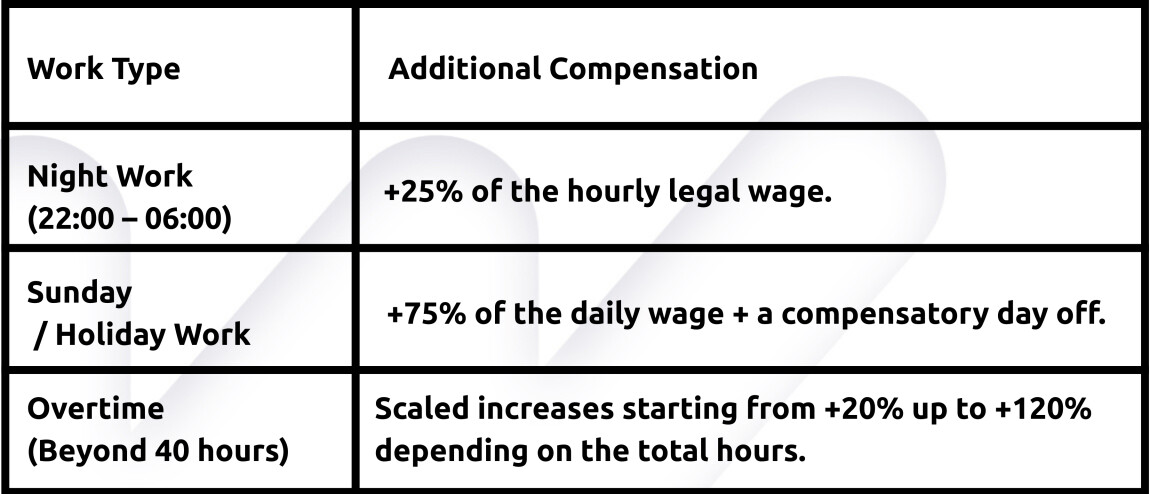
|
Work Type |
Additional Compensation |
|
Night Work (22:00 – 06:00) |
+25% of the hourly legal wage. |
|
Sunday / Holiday Work |
+75% of the daily wage + a compensatory day off. |
|
Overtime (Beyond 40 hours) |
Scaled increases starting from +20% up to +120% depending on the total hours. |
The Hybrid Reality: What This Means for Employers
For companies operating in Greece, compliance is no longer optional. The ERGANII II digital card system is being rolled out to track working hours in real-time. This digital transformation aims to eliminate unpaid overtime and ensure that the "hybrid" dream stays sustainable.
The takeaway for the Greek workforce? Your home is your office, but your time remains your own. Whether you are working from a balcony in Koukaki or a co-working space in Thessaloniki, the law is increasingly on the side of the digital balance.
Expert Insight: Staying Compliant
If you are an employer or a remote worker in Greece, it is vital to have a written Telework Agreement. This document should clearly outline:
- The specific "disconnection" hours.
- The breakdown of utility cost reimbursements.
- The method of time-tracking to ensure weekend and night shift premiums are calculated correctly.
Conclusions: Respecting the Balance
The shift to hybrid work in Greece is a modern evolution of the local labor market. By legally protecting the Right to Disconnect and requiring employers to cover utility costs, the law ensures that flexibility does not lead to employee burnout or unfair expenses.
Ultimately, the success of this model relies on transparency. Employees are now more aware of their rights regarding overtime and remote allowances, while employers must adapt to stay competitive. In the new Greek workspace, productivity is no longer measured by constant availability, but by a healthy, sustainable balance between professional goals and personal time.
Share
What I read is worth it:
Article written by:
 wherewework.gr
Comments
0 comments
No comments! Be the first to comment on this article!

Access your account and add your comment
Legislative


Subscribe to the Newsletter
Read articles of interest from wherewework.gr contributors
