
Share
What public holidays do we have in 2027?
27/10/2026
6 min

Planning next year’s breaks starts with one simple question: which days can we actually count on? For most of us working in Greece’s private sector, the answer for 2027 is a little disappointing.
The Labour Code sets nine statutory holidays, but four of them land on a Saturday or a Sunday in 2027, and Greek law does not hand back a weekday when that happens. Only May Day gets rescued: because 1 May 2027 is Holy Saturday, the holiday is expected to move to Tuesday 4 May. That leaves us with 6 days off on working days in 2027, against 7 in 2026, while 3 holidays simply disappear into the weekend.
Below you’ll find the full calendar, what you are owed if you work on a holiday, and five bridge plans that stretch a handful of leave days into proper breaks.
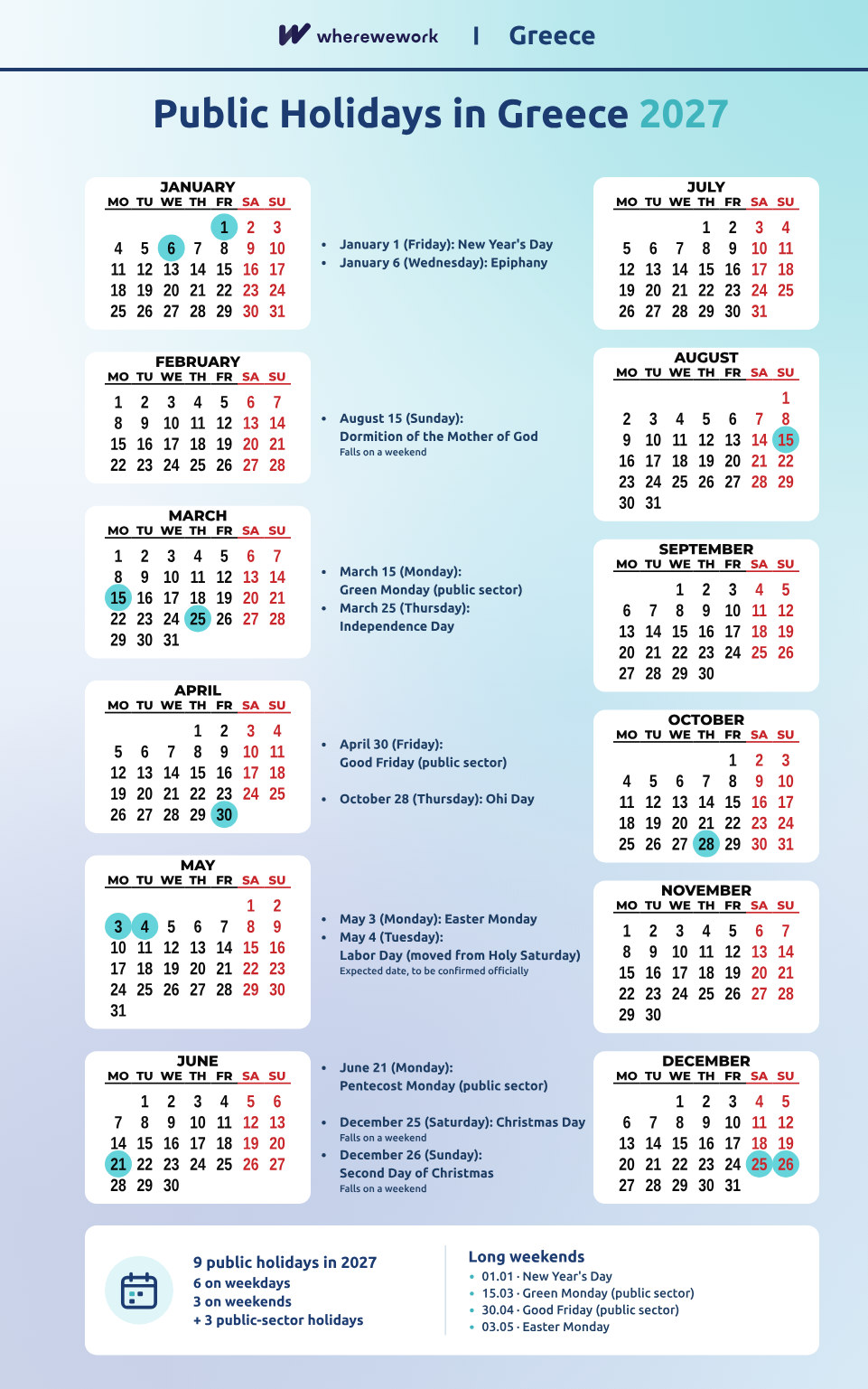
The full 2027 holiday calendar for Greece
The nine statutory holidays come from Article 203 of Greece’s Labour Code (Κώδικας Εργατικού Δικαίου, Presidential Decree 62/2025, published in the Government Gazette on 11 July 2025), which governs private-sector employment in Greece. Days marked public sector are paid days off for civil servants and schoolchildren, but normal working days for most private-sector staff.
- 1 January (Friday): New Year’s Day
- 6 January (Wednesday): Epiphany
- 15 March (Monday): Clean Monday, public sector and schools only
- 25 March (Thursday): Independence Day and the Annunciation
- 30 April (Friday): Good Friday, public sector only; shops stay closed until 13:00
- 1 May (Saturday): May Day, which coincides with Holy Saturday
- 3 May (Monday): Easter Monday
- 4 May (Tuesday): May Day holiday, expected new date, not yet officially announced
- 21 June (Monday): Holy Spirit Monday, public sector only
- 15 August (Sunday): Dormition of the Theotokos
- 28 October (Thursday): Ochi Day
- 25 December (Saturday): Christmas Day
- 26 December (Sunday): Second day of Christmas
Easter Sunday itself falls on 2 May 2027. Count only the statutory holidays that land Monday to Friday and you get 6 days off on working days: 1 January, 6 January, 25 March, 3 May, the expected 4 May and 28 October. In 2026 the same count was 7.
Why May Day is still marked as expected
Under Article 14 of Law 4468/2017, when 1 May coincides with a Sunday, a day of Holy Week or Easter Monday, the Labour Minister moves the holiday to another working day by decision. With Orthodox Easter on 2 May 2027, May Day is Holy Saturday, so a transfer is due.
The calendar repeats 2021 exactly, when a ministerial decision of 14 April moved the holiday to Tuesday 4 May. Transfers followed in 2022 and 2024 too, with the 2024 decision announced as early as late February. Until the 2027 decision is published, treat 4 May as likely, not confirmed.
Working on a holiday: what you are owed
If your employer keeps going on a statutory holiday, Article 219 of the Labour Code entitles you to a 75% premium for the hours you work, whatever was agreed about that shift. The premium applies on Sundays and on all nine statutory holidays, and it is always calculated on statutory minimum pay: the legal daily wage if you are paid by the day, or 1/25 of the legal monthly salary if you are paid by the month.
One catch: working a statutory holiday does not earn you a day off in lieu. Sunday work is different. Work more than 5 hours on a Sunday and Article 212 gives you 24 consecutive hours of compensatory rest on another working day of that week. Your employer cannot count a rest day you are already owed as your holiday either, according to guidance from KEPEA, the labour information centre of the GSEE workers’ confederation.
Two 2027 holidays fall on a Sunday, 15 August and 26 December. KEPEA’s guidance is that the 75% premium is owed once, not twice, when a Sunday and a holiday coincide, while the Sunday rest rules still apply. If you are paid by the day and a holiday lands on your rest day, you are still owed an extra daily wage for that week; on a monthly salary, your pay stays the same however many holidays fall in the month.
For employers the stakes are real. A business without a legal exemption needs a special permit from the Labour Inspectorate, requested through sepenet.gr by 13:00 on the working day before, and GSEE classes unlawful work on a mandatory holiday as a very serious violation, with a heavy fine and possible criminal liability for the employer.
Before you say yes to a holiday shift, work out what the premium actually adds to your net salary, starting from your gross salary. It is worth checking how your salary compares with what others in the same role earn, too. And if you work in a sector that keeps going on holidays, such as shops, hospitals, restaurants or transport, look up the salaries for those jobs in Greece before you negotiate.
Days off that depend on where you work
Clean Monday, 15 March 2027, is the day most often misunderstood. Both KEPEA and PwC Greece’s payroll team point out that it is not a statutory holiday for private-sector employees, so it is a normal working day unless your collective agreement or company custom says otherwise.
The public sector gets more. Under Article 204 of the Labour Code, state employees covered by the code also receive the holidays that apply to permanent civil servants, which in 2027 means Clean Monday, Good Friday (30 April) and Holy Spirit Monday (21 June). In the private sector, Good Friday only brings a half day for retail: shops cannot open or employ staff until 13:00.
If you are a parent, mark 15 March. According to Alfavita’s 2026/2027 school calendar, Clean Monday gives pupils the first three-day weekend of 2027, so you may need childcare or a leave day. Holy Spirit Monday matters less for families in 2027: it falls after schools have closed for the summer.
Five bridge plans for 2027
Every plan below treats Clean Monday, Good Friday and Holy Spirit Monday as working days, because that is what they are for most private-sector staff. Leave days are counted on a Monday to Friday week.
- New Year. Friday 1 January gives you a free 3-day weekend, Friday 1 to Sunday 3 January, for 0 leave days. For the whole festive stretch, take Monday 28, Tuesday 29, Wednesday 30 and Thursday 31 December 2026 (4 leave days) and you are off for 10 days, from Friday 25 December 2026 to Sunday 3 January 2027. Those leave days fall in 2026, so plan them with your 2026 leave.
- Epiphany. Take Thursday 7 and Friday 8 January (2 leave days) for 5 days off, Wednesday 6 to Sunday 10 January. Or take Monday 4, Tuesday 5, Thursday 7 and Friday 8 January (4 leave days) for 10 days off, Friday 1 to Sunday 10 January.
- 25 March. Take Friday 26 March (1 leave day) for 4 days off, Thursday 25 to Sunday 28 March. For a full week, take Monday 22, Tuesday 23, Wednesday 24 and Friday 26 March (4 leave days) for 9 days off, Saturday 20 to Sunday 28 March.
- Easter and May Day. If May Day moves to Tuesday 4 May as expected, Saturday 1 to Tuesday 4 May is a free 4-day break for 0 leave days. Add Wednesday 5, Thursday 6 and Friday 7 May (3 leave days) and you get 9 days off, Saturday 1 to Sunday 9 May. If the decision names a different date, recount before you book.
- Ochi Day. Take Friday 29 October (1 leave day) for 4 days off, Thursday 28 to Sunday 31 October. Or take Monday 25, Tuesday 26, Wednesday 27 and Friday 29 October (4 leave days) for 9 days off, Saturday 23 to Sunday 31 October.
Summer and Christmas offer no free bridge in 2027: 15 August is a Sunday and both Christmas holidays fall on the weekend, so any break around them comes entirely out of your leave allowance.
Plan smart, rest well
The quieter weeks around the holidays are a good moment to update your CV and to browse open jobs without the usual rush. If a job interview is on the cards, ask how the employer handles work on public holidays and whether it offers extra days off: in a year as thin as 2027, the answer matters.
Fewer free days means each one counts for more. Book your bridges early, watch for the May Day decision in spring, and 2027 can still give you proper breaks.
Share
What I read is worth it:
Read all the articles about
About the crafts Balance Career planning Economic Entrepreneurs Employee experience HR Coach HR Metrics Guide Labour market Negotiation Students Workforce planning LegislativeArticle written by:
 wherewework.gr
Comments
0 comments
No comments! Be the first to comment on this article!

Access your account and add your comment
About the crafts


Subscribe to the Newsletter
Read articles of interest from wherewework.gr contributors
