Share
Minimum Wage in Greece in 2025: Current Level, Recent Evolution and Outlook
28/11/2025
3 min
Greece’s minimum wage has long been a central topic in national labour-market debates. After years marked by economic adjustment, structural reforms and efforts to restore purchasing power, the country has entered a phase of steady wage recovery. The minimum wage is now seen not only as a tool for protecting low-income workers but also as a strategic instrument for supporting domestic demand, social cohesion and economic resilience. The 2025 increase reflects these priorities and places Greece among the more advanced economies in Southeast Europe in terms of minimum-income protection.
1. What is the minimum wage in 2025 and to whom it applies
Starting 1 April 2025, the statutory minimum gross monthly wage in Greece is set at €880. This amount applies to full-time employees across all sectors under standard employment contracts. For workers who are paid daily, the statutory minimum daily wage is €39.30 per day.
The minimum wage represents the lowest legally acceptable base salary and excludes any form of bonuses, allowances or additional benefits that may be included in collective agreements. Once set, the rate becomes binding nationwide and cannot be lowered by individual or sectoral employment contracts.
2. How the minimum wage evolved in recent years (2022–2025)
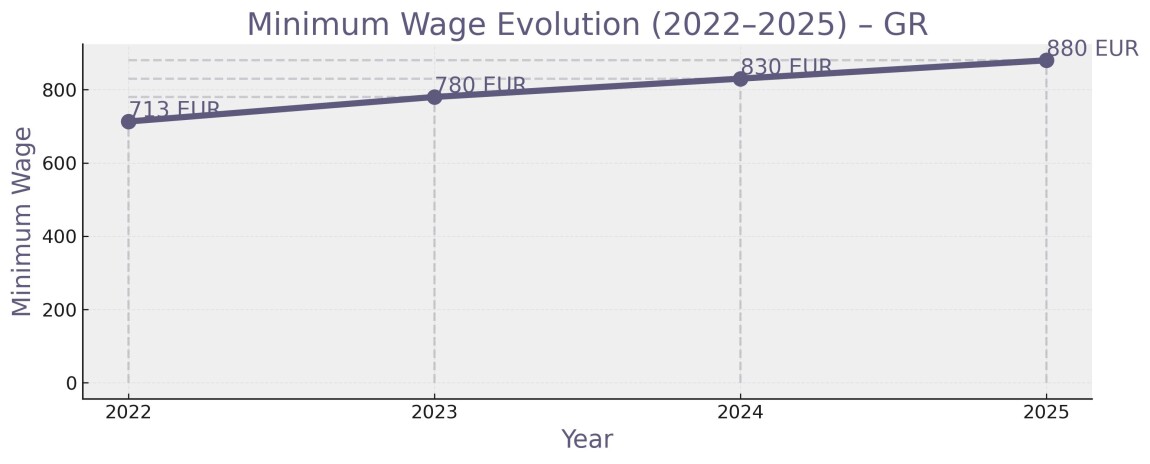
Between 2022 and 2025, Greece implemented a series of gradual increases to restore wage levels and improve living standards. In the early 2020s, the minimum wage had remained frozen for a long period due to the financial crisis. Beginning in 2022, the government resumed regular updates, raising the national rate from the low €700s to €830 in 2024. The most recent update, effective April 2025, increased the rate to €880, marking another significant step in the country’s wage-recovery path.
This upward trend reflects government efforts to reduce the gap between low wages and rising living costs, as well as to align Greece more closely with European recommendations on adequate minimum wages.
3. What the 2025 minimum wage means in practice
With the minimum wage set at €880 gross per month, Greece positions itself above many other countries in Southern and Eastern Europe in terms of statutory wage floors. While the increase provides meaningful support to low-income earners, its real effect depends strongly on local living costs, which are considerably higher in major cities like Athens compared to smaller towns or rural areas.
Compared to Greece’s average gross salary, typically around €1,300–€1,500 per month, the minimum wage remains below the median but still represents a reinforced income floor. For full-time workers, this increase helps offset part of the inflationary pressures accumulated over the past years, particularly in areas such as housing, utilities and transportation.
4. The regulatory context and how the minimum wage is determined
Greece’s minimum wage is set directly by the national government rather than through sector-wide collective bargaining. The process involves consultations with employers’ organisations, trade unions, economists and independent bodies. After these consultations, the Ministry of Labour issues a formal decision establishing the new minimum wage level.
This system aims to create a more predictable and stable framework for wage adjustments, balancing economic feasibility with social protection. The 2025 update follows this mechanism and reflects the government’s intention to maintain regular and transparent revisions of the wage floor.
5. Sector-specific considerations
Greece does not operate with multiple statutory minimum wages across different sectors. Instead, the single national minimum wage applies universally to nearly all employees, ensuring consistency and equal treatment across industries. Exceptions exist primarily for certain categories of daily-paid or seasonal workers, who are covered by the daily minimum wage rate rather than the monthly one.
Beyond this, additional benefits, allowances or sectoral bonuses may be negotiated through collective agreements, but these cannot reduce the legally defined base wage.
Conclusions
The increase of Greece’s minimum wage to €880 per month in 2025 reinforces the country’s commitment to supporting low-income workers and navigating the challenges posed by rising living costs. While the new rate offers improved income security, it remains below the national average salary, meaning that purchasing-power challenges persist, especially in high-cost regions.
For employers, the adjustment brings higher labour expenses and may influence workforce planning and cost structures. At the same time, the predictable and structured decision-making process for setting minimum wages provides greater clarity for both employers and employees. If current economic trends continue, Greece is expected to introduce further moderate increases in the coming years as it moves toward more robust wage adequacy standards.
Share
What I read is worth it:
Article written by:
 wherewework.gr
Comments
0 comments
No comments! Be the first to comment on this article!

Access your account and add your comment
Legislative


Subscribe to the Newsletter
Read articles of interest from wherewework.gr contributors
