Share
Greece's €1.4bn food and beverage capex wave: 162,000 workers
22/09/2026
6 min
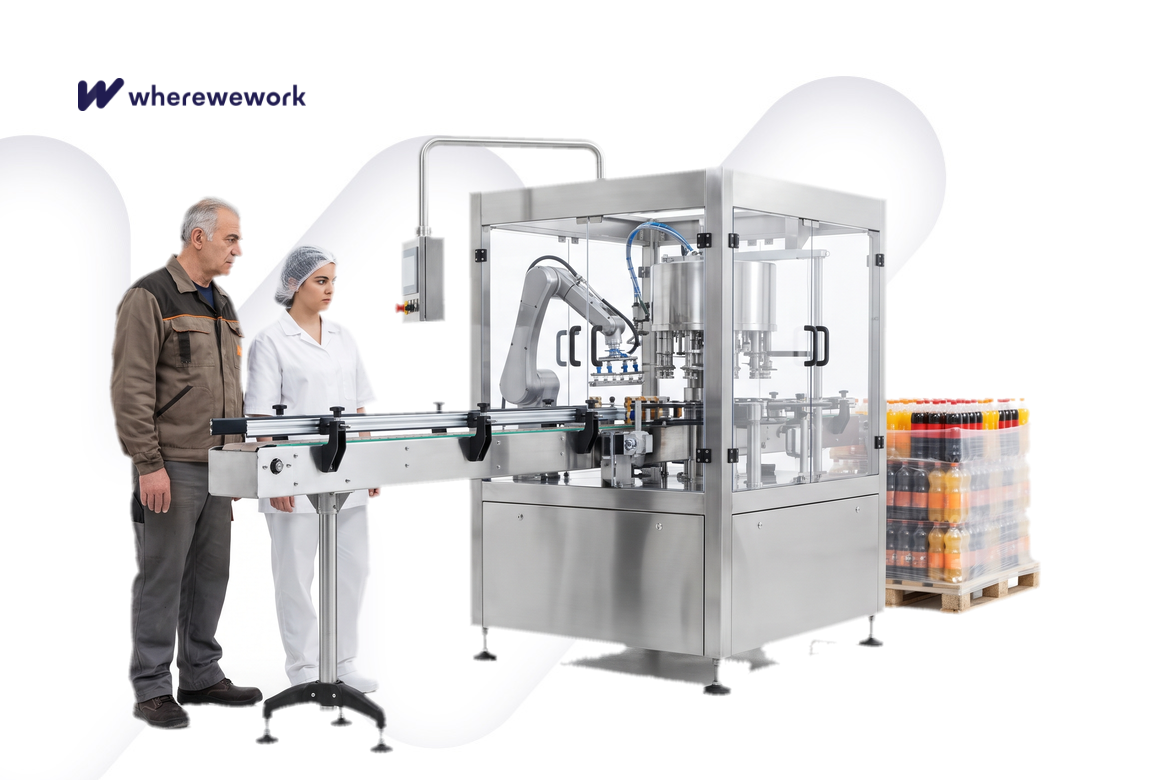
Greece's food and beverage industrialists are pouring €1.4 billion into new plants, automated lines and export capacity, according to reporting by Efimerida ton Syntakton. The sector already employs more than 162,000 people and accounts for 15% of total Greek exports, which makes this the second-largest industrial employer in the country. What the reporting does not tell you, and what nobody in the sector is saying out loud, is how many of those 162,000 jobs will look the same in three years.
If you work on a line at Nitsiakos, Coca-Cola HBC, Athenian Brewery, Chitos or Barba Stathis, or if you recruit for any of them, this article is for you. The numbers are public. The employment impact is not.
Where the €1.4 billion is going
The single biggest ticket this year belongs to poultry producer Nitsiakos, with a €167 million plan anchored by a new slaughterhouse in the Ioannina Industrial Area. The new facility is designed to process 15,000 chickens per hour, up from roughly 8,000 today. Nearly half of the investment is financed through loans from the Recovery Fund, and the main Ioannina production project is targeted for completion in 2026.
Coca-Cola HBC, Greece's most valuable listed company at €19.8 billion market capitalisation, has invested €180 million since 2020. Its current programme includes a new PET bottle production line at Schimatari worth €20 million and a new logistics centre in Attica budgeted at approximately €31 million, both scheduled for completion by 2028.
The rest of the map, drawn from the same reporting:
- MEVGAL: €160 million for a new 48,000 sq.m. dairy plant next to its Koufalia site, partial operation in summer 2027, full operation early 2028.
- ION: €143.1 million, centred on a new chocolate plant in Stylida and modernisation in Arta.
- Amvrosiadis Kotopoula Olympou: €105 million in two phases through 2032, with about €75 million in phase two.
- Glaros group (Sklavenitis family): €100 million for a ready-meals facility in Magoula, up to 250,000 portions daily, roughly 300 workers.
- Athenian Brewery: about €60 million over the past decade at its Patras plant, the largest brewery in Greece, plus a 5.75 MW solar-thermal park covering up to 25% of the plant's thermal energy needs.
- E.I. Papadopoulos (biscuits): €59.6 million at its Volos plant, where Caprice is produced, for new automated production and packaging lines.
- Kri Kri (Tsinavos family): €52.2 million 'Greek Yogurt Dynamo' project in Serres, classified under Strategic Investments.
- Chitos: over €40 million completed on bottling lines and modernisation at Ioannina and Zireia.
- Stavros Nendos – Artopoiia Select: €34.95 million bakery in VIPETH Sindos under the 'Large Investments' regime.
- Lavdas (ION subsidiary): over €32 million for a new confectionery facility in Gastouni, operating from January 2027.
- Angelakis: €30 million to expand its Evia poultry units, final stage expected by year-end.
- Barba Stathis: €6.5 million in 2025, part of a six-year €35 million programme.
- Xino Nero: about €3.7 million on a new bottling plant in Florina, projected productivity gain of roughly 200%.
- Artoma Diethneis Zymes: €3.48 million to expand its frozen dough facility in VIPE Kilkis, with a €2.09 million tax exemption under the Special Aid Areas regime.
The reporting describes three pillars behind the spend: production increase and new lines, green transition and supply chain, and export orientation. Two of the three (new lines and supply-chain overhaul) are where automation lives.
For employees: what higher throughput usually means for line jobs
The most concrete number in the whole dossier is the Nitsiakos throughput jump: from about 8,000 chickens per hour to 15,000. That's roughly 88% more output per hour, from a single upgraded facility. Xino Nero, at the other end of the size spectrum, projects a productivity rise of roughly 200% at its Florina bottling plant.
None of the announcements say how many people will be on the new lines. The Glaros ready-meals plant in Magoula is the only one that publishes a headcount: approximately 300 workers for 250,000 portions daily. Every other announcement gives you output, floor space and euros, but not headcount.
If you work on a line today, that silence matters. Higher throughput per hour, delivered by new lines rather than more shifts, historically compresses the number of manual roles per unit of output. It also tends to shift the role mix: fewer general operatives, more machine operators, quality-control technicians, maintenance and PLC-literate staff. Wages usually follow the mix (more technical roles pay more), but the total number of jobs at a modernised plant can go up, stay flat, or fall depending on whether the company is growing its export book fast enough to absorb the extra capacity.
Concrete things you can do this quarter if you work in one of these plants or want to:
- Ask your line manager or works council what the new-line staffing plan looks like and when the transition happens. "By 2026" or "by 2028" is a real timeline you can plan around.
- Check the local minimum wage floor against what you actually earn, and check the collective agreement covering your plant. Modernised sites often renegotiate grade structures.
- Look at employer reviews from other workers at the same company or sector before deciding whether to move, retrain or stay put.
- If you're actively looking, filter jobs by "food production", "packaging operator", "quality control" or "maintenance technician" in the regions where the capex is landing: Ioannina, Attica, Patras, Serres, Volos, Magoula, Stylida, Evia, Florina, Kilkis.
For HR and recruiters: the workforce planning question nobody's answering
Fourteen major projects, €1.4 billion, and one publicly disclosed headcount (300 workers at the Glaros Magoula plant). That's the workforce-planning gap you're recruiting into.
Three things are worth pinning down internally before the 2026 to 2028 completion window closes:
1. Net headcount forecast per new line. A doubling of throughput at Nitsiakos, or a 200% productivity gain at Xino Nero, does not automatically mean fewer people. It means fewer people per unit of output. If the export book grows fast enough (and export orientation is one of the three declared pillars), the plant can absorb more volume with a similar or larger workforce, but in a different skills mix. If the export book doesn't grow, you're looking at attrition-managed reduction. HR teams should be pressing operations for the underlying volume assumption, not the productivity number.
2. The skills-mix pivot. Automated lines change the ratio of general operatives to technical roles: machine operators, maintenance technicians, PLC and automation specialists, quality-control staff, cold-chain and logistics coordinators (Coca-Cola HBC's new Attica logistics centre is a €31 million signal on the last one). Recruitment pipelines built for the previous mix will underdeliver on the new one. Upskilling internal staff into technical roles is almost always cheaper than external hiring at scale, especially in regional labour markets like Ioannina, Florina or Serres where technical talent is thin.
3. Wage pressure at modernised plants. A more technical role mix pushes average wages up, but not uniformly. Salary bands for machine operators and maintenance technicians in food manufacturing are typically 20 to 40% above general operative rates. If your plant is one of the fourteen and your compensation framework hasn't been reviewed against the post-upgrade role mix, you'll either overpay to attract externally or lose the internal candidates you should be upskilling. Salary negotiation conversations at modernised sites tend to move faster than pay reviews, so the framework needs to be in front of the transition, not behind it.
The €1.4 billion is a leading indicator. Employment impact is a lagging one. The gap between the two is where your workforce plan lives.
What we don't know yet
Four things are missing from the public picture and worth watching over the next 12 months:
- Net job creation or displacement per project. Only Glaros has published a number.
- Reskilling budgets tied to Recovery Fund financing (Nitsiakos in particular, given roughly half of its €167 million comes from that route).
- Regional wage effects in Ioannina, Serres and Volos, where multiple projects concentrate.
- The collective agreement response, plant by plant, as new lines come online.
A €1.4 billion capex wave in a 162,000-worker sector isn't neutral. It reshapes who works where, at what skill level, for what pay. The companies have committed the money. The employment story is the one still to be written, and the people it's about (line workers, technicians, HR teams, recruiters) will write it in the next 24 months.
Share
What I read is worth it:
Article written by:
 wherewework.gr
Comments
0 comments
No comments! Be the first to comment on this article!

Access your account and add your comment
HR Metrics


Subscribe to the Newsletter
Read articles of interest from wherewework.gr contributors
